
General Gardening
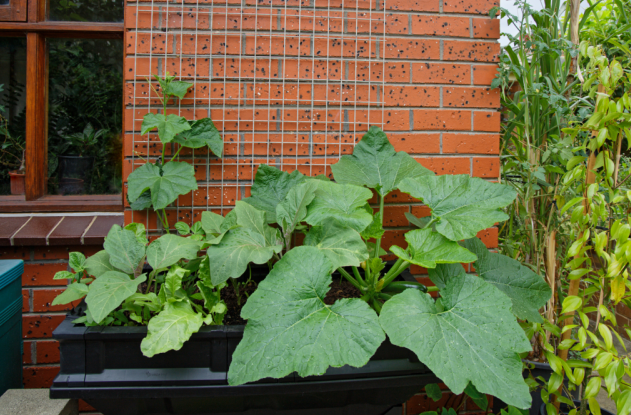
Warm-season vegetables and fruit trees are often planted near brick, stone, and concrete walls that receive midday or afternoon sunlight. The reason is simple: these materials act as thermal mass, absorbing heat during the day and slowly releasing it after sunset.
This stored heat can create a warmer microclimate around nearby plants, helping extend the growing season for heat-loving crops such as tomatoes, eggplants, chillies, cucumbers, and pumpkins. It can also provide some protection against cooler temperatures and light frost conditions.
As gardeners increasingly focus on climate-resilient and sustainable growing methods, using natural heat storage from existing structures has become an effective way to improve garden performance without additional energy use.
How Does a Brick Wall Thermal Mass Affect Winter Temperatures?
The best way to understand how much heat a thermal mass can provide is through observation and experimentation.
To test the effect of a brick wall during winter, an experiment was conducted at the beginning of the cold season. Temperatures were measured every hour from midday until evening on two brick walls:
- One wall facing the midday sun.
- One wall facing away from the sun and remaining shaded.
- The surrounding air temperature was also measured for comparison.
At midday, the outside temperature was relatively cool at 13.5°C (56.3°F).
Using an infrared thermometer, the temperature of the sun-facing brick wall was measured at approximately head height. The result was surprising—the wall temperature reached 38.7°C (101.66°F), almost three times warmer than the surrounding air.
Meanwhile, the shaded brick wall remained close to the air temperature at 13.7°C (56.66°F).
This demonstrates an important principle:
A wall exposed to sunlight can absorb significant heat, while a shaded wall behaves much more like the surrounding environment.
Measuring Heat Retention After Sunset
The next question was not only how much heat the wall absorbs, but how long it can retain that heat.
Measurements were taken every hour for eight hours, including after sunset, to observe how quickly the stored heat was released.
| Time | Air Temperature (°C) | Sun-Facing Wall (°C) | Shaded Wall (°C) |
|---|---|---|---|
| 12:00 PM | 13.5 | 38.7 | 13.7 |
| 1:00 PM | 14.4 | 40.5 | 14.2 |
| 2:00 PM | 14.1 | 30.8 | 15.3 |
| 3:00 PM | 14.0 | 30.2 | 14.7 |
| 4:00 PM | 11.2 | 26.3 | 14.5 |
| 5:00 PM | 7.8 | 21.0 | 14.0 |
| 6:00 PM | 6.5 | 16.9 | 13.0 |
| 7:00 PM | 7.0 | 16.2 | 12.4 |
| 8:00 PM | 5.7 | 13.7 | 12.4 |
The results show that the sun-facing wall reached its highest temperature of 40.5°C (104.9°F) at 1:00 PM before gradually cooling throughout the afternoon and evening.
By 8:00 PM, the wall was still warmer than the shaded wall and significantly warmer than the outside air, which had dropped to only 5.7°C (42.26°F).
Even the shaded wall maintained a relatively stable temperature throughout the day, demonstrating that brick structures can moderate temperature changes compared with exposed air.
What Does This Mean for Gardeners?
Although this experiment was limited and did not continue into early morning hours, it clearly demonstrates that brick walls can influence the surrounding garden environment.
A sun-facing wall can:
- Absorb heat during daylight hours.
- Release stored warmth after sunset.
- Create a warmer growing zone for nearby plants.
- Help protect sensitive plants during cooler seasons.
This technique is commonly used in microclimate gardening, where gardeners take advantage of existing structures, sunlight patterns, and natural heat storage to improve plant growth.
For example, placing heat-sensitive plants near a warm brick wall can help them survive colder nights and begin producing earlier in the season.
How Much Heat Do Different Materials Store?
The ability of a material to store heat depends on its specific heat capacity.
Specific heat capacity refers to the amount of energy required to raise the temperature of 1 kilogram of a material by 1°C.
Materials with higher specific heat capacity can store more heat energy and release it over a longer period.
Interestingly, water has one of the highest heat capacities of common materials, meaning it can store a significant amount of thermal energy.
Heat Storage Capacity of Common Materials
| Material | Specific Heat Capacity (J/kg·°C) |
| Water | 4187 |
| Oak Wood | 2380 |
| Soil | 1810 |
| Asphalt | 915 |
| Aluminium | 887 |
| Concrete | 879 |
| Clay | 878 |
| Brick | 841 |
| Glass | 792 |
| Sand | 780 |
| Cast Iron | 554 |
| Iron | 462 |
The table shows that water requires nearly five times more energy to heat by 1°C compared with brick, meaning large water sources can store considerably more heat.
This explains why features such as:
- Water tanks
- Ponds
- Lakes
- Large containers of water
can act as powerful thermal masses in garden design.
Using Thermal Mass in Sustainable Garden Design
Understanding how different materials respond to heat allows gardeners to design more productive and resilient outdoor spaces.
Practical ways to use thermal mass include:
- Planting frost-sensitive vegetables near sunny brick or stone walls.
- Positioning water tanks near growing areas to store daytime heat.
- Using stone pathways and garden walls to moderate temperature changes.
- Combining thermal mass with greenhouses or protected growing areas.
These simple design choices can help create warmer garden microclimates, extend growing seasons, and support healthier plants with minimal environmental impact.
While thermal mass is not a replacement for frost protection in extreme conditions, it is a valuable tool for gardeners looking to work with natural energy and create a more sustainable, productive garden.